Hey there! As a supplier of welded chains, I've seen firsthand how crucial it is to improve the fatigue life of these chains. Welded chains are used in a wide range of applications, from industrial machinery to lifting and towing equipment. And let's face it, nobody wants a chain to fail prematurely due to fatigue. So, in this blog post, I'm going to share some tips on how to improve the fatigue life of welded chains.
Understanding Fatigue in Welded Chains
Before we dive into the tips, let's first understand what fatigue is and how it affects welded chains. Fatigue is the progressive and localized structural damage that occurs when a material is subjected to cyclic loading. In the case of welded chains, cyclic loading can occur due to repeated bending, stretching, and torsion. Over time, these cyclic loads can cause cracks to form in the chain, which can ultimately lead to failure.
The fatigue life of a welded chain is influenced by several factors, including the material properties, the welding process, the chain design, and the operating conditions. By addressing these factors, we can significantly improve the fatigue life of welded chains.
Choosing the Right Material
The material used to make the welded chain plays a crucial role in its fatigue life. Different materials have different mechanical properties, such as strength, toughness, and ductility, which can affect how the chain responds to cyclic loading.
For high-stress applications, it's recommended to use high-strength materials, such as alloy steels. Alloy steels have a higher strength-to-weight ratio than carbon steels, which means they can withstand higher loads without deforming. One example of a high-strength alloy chain is the Grade 80 Alloy Chain. This chain is made from a special alloy steel that has excellent fatigue resistance and is suitable for heavy-duty lifting and towing applications.
In addition to strength, the toughness and ductility of the material are also important. Toughness refers to the ability of the material to absorb energy without fracturing, while ductility refers to the ability of the material to deform plastically without breaking. Materials with high toughness and ductility are less likely to crack under cyclic loading, which can improve the fatigue life of the chain.
Optimizing the Welding Process
The welding process used to join the links of the chain is another critical factor that can affect its fatigue life. A poorly welded chain can have weak spots or defects that can act as stress concentrators, which can accelerate the formation of cracks and reduce the fatigue life of the chain.
To ensure a high-quality weld, it's important to use the right welding technique and parameters. For example, the welding current, voltage, and travel speed should be carefully controlled to ensure a uniform and consistent weld. In addition, the welding wire or electrode should be compatible with the base material of the chain to ensure good weld quality.
Another important aspect of the welding process is the post-weld treatment. After welding, the chain should be heat-treated to relieve any residual stresses that may have been introduced during the welding process. Residual stresses can act as stress concentrators and reduce the fatigue life of the chain. Heat treatment can also improve the mechanical properties of the weld, such as its strength and toughness.
Designing the Chain for Fatigue Resistance
The design of the welded chain can also have a significant impact on its fatigue life. A well-designed chain should be able to distribute the load evenly across all the links, which can reduce the stress concentration and improve the fatigue resistance of the chain.
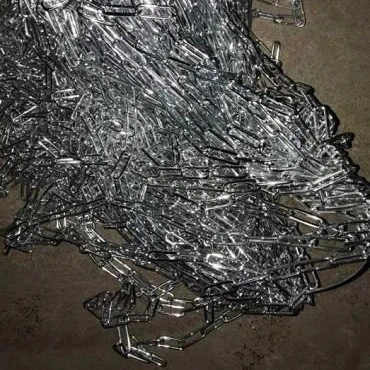

One way to improve the load distribution is to use a chain with a larger pitch. A larger pitch means that the links are farther apart, which can reduce the bending stress on each link. In addition, the shape of the links can also affect the load distribution. For example, links with a rounded or oval shape can distribute the load more evenly than links with a square or rectangular shape.
Another important design consideration is the use of proper fittings and attachments. The fittings and attachments should be designed to match the chain and should be able to transfer the load smoothly and evenly. Improperly designed or installed fittings and attachments can cause stress concentrations and reduce the fatigue life of the chain.
Controlling the Operating Conditions
The operating conditions of the welded chain can also affect its fatigue life. Factors such as the load magnitude, the frequency of the cyclic loading, the temperature, and the environment can all have an impact on the fatigue performance of the chain.
To improve the fatigue life of the chain, it's important to operate it within its design limits. Overloading the chain can cause excessive stress and accelerate the formation of cracks. In addition, the frequency of the cyclic loading should be kept within a reasonable range. High-frequency cyclic loading can cause the chain to heat up, which can reduce its strength and fatigue resistance.
The temperature and environment can also affect the fatigue life of the chain. High temperatures can cause the material to soften and reduce its strength, while corrosive environments can cause the chain to rust and weaken. To protect the chain from the effects of temperature and environment, it's recommended to use appropriate coatings or lubricants.
Regular Inspection and Maintenance
Regular inspection and maintenance are essential for ensuring the long-term performance and safety of welded chains. By inspecting the chain regularly, we can detect any signs of wear, damage, or fatigue early on and take appropriate measures to prevent failure.
During the inspection, we should check for signs of cracks, wear, deformation, and corrosion. Any damaged or worn links should be replaced immediately to prevent further damage to the chain. In addition, the chain should be cleaned and lubricated regularly to reduce friction and wear.
Conclusion
Improving the fatigue life of welded chains is a complex process that requires a comprehensive approach. By choosing the right material, optimizing the welding process, designing the chain for fatigue resistance, controlling the operating conditions, and performing regular inspection and maintenance, we can significantly extend the service life of welded chains and ensure their safe and reliable operation.
If you're in the market for high-quality welded chains or have any questions about improving their fatigue life, please don't hesitate to contact us. We're here to help you find the right solution for your specific needs.
References
- ASME B30.9 - Slings
- ISO 3077 - Welded steel chains for general lifting purposes
- DIN 763 - Welded steel chains, grade T, for general lifting purposes
- DIN 764 - Welded steel chains, grade G, for general lifting purposes